The Wallace Collection
- Apr 25, 2018
- 7 min read

One of my absolute favorite museums in the world is the Wallace Collection in London. It is an art collection housed in the Hertford House in Manchester Square. The majority of the art comes from the collection of Richard Seymour-Conway, 4th Marquess of Hertford who left the collection to his illegitimate son, Sir Richard Wallace. Once Richard died his widow bequeathed the entire collection to England. It is an extremely beautiful venue with some of the most incredible Old Master works in the world. Below is a paper that I wrote after one of my visits, in which I went in depth about several key paintings that I loved from the collection. If you have the opportunity to visit the Wallace Collection you cannot miss seeing any of these paintings.


The Wallace Collection is a beautiful private home that was converted into a museum after the owner passed away. She bequeathed it to England with the stipulated that none of the artworks or furniture could be sent away on loan to other museums. The first painting that we discussed, A Dance to the Music of Time, was by the French artist Nicholas Poussin. In the painting, viewers can detect specific figures by their attributes, such as Time, Janus, and the 4 Seasons. The artist included an hourglass and bubbles, who fragility represent the fleeting nature of time. This painting includes personifications of days, seasons, and years, showing that time is ever changing. The next painting that we looked at in the Great Gallery was the River Landscape with Apollo and the Cumean Sybl by Salvator Rosa. This painting shows the story of Apollo granting the Cumean Sybl a wish. She wished for as many years of life as there are grains of sand around her. However, she forgot to ask to remain young for all of these years that she is granted. The artist represents the darkness of the story through the darkness of the chiaroscuro and color palette that he uses. This artists included the classical story within the detailed landscape in order for the painting to be considered high art. Another painting that we studied was Time Saving Truth From Falsehood and Envy by Francois Lemoyne. The figures in the painting can be determined by the attributes that the artist gives them. For example, Falsehood is represented by a mask and Time is identifiable by his scythe. This type of allegorical painting was very common when Lemoyne painted it in the 18th century. Another important allegorical painting in the Grand Gallery is the Rape of Europa after Titian. In the story in this paining, Zeus turns himself into a bull, and after Cupid shoots her with an arrow she falls in love with Zeus as the bull. The artist painted Europa in a crude pose because Titian often painted women in crude poses for King Phillip of Spain. The final painting that we focused on in the Grand Gallery was The Laughing Cavalier by Frans Hals. When it was painted in the 17th century, it was unusual for an artist to paint a portrait of someone smiling. If the subject was smiling or laughing, it often signaled that they were drunk or mad. However, this painting did align with Dutch 17th century art because many artists stopped painting religious imagery, and painted landscapes and portraits instead. One of the most remarkable parts of the painting is the effect that the brush strokes have on the lace. The attention to detail on the lace and the clothing shows the skill of Hals.
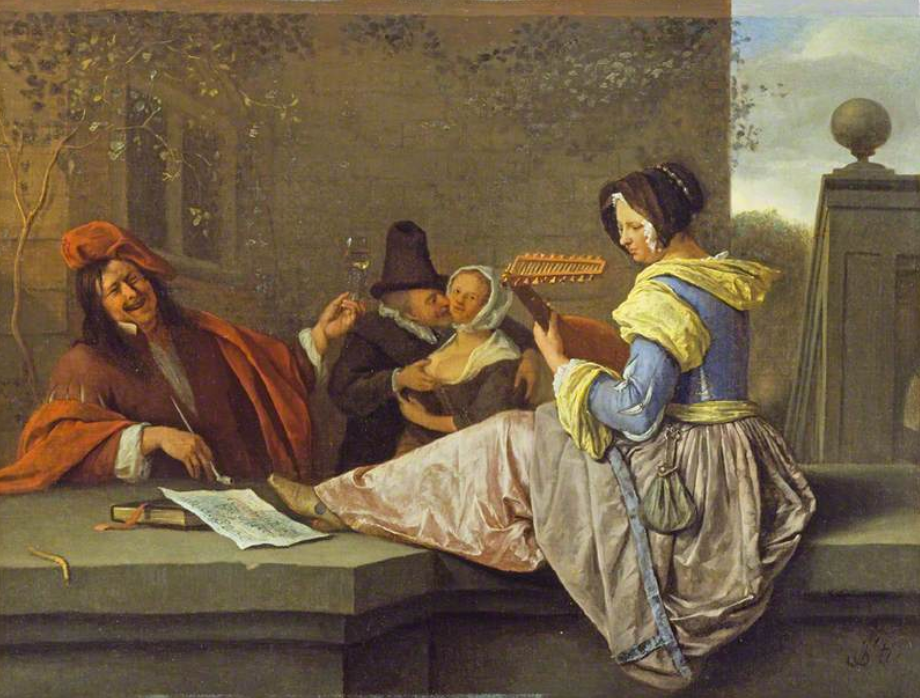
The next room that we looked at in the Wallace Collection was the Dutch art room. There were many paintings by Jan Steen. Several that we focused on were Celebrating the Birth and The Lute Player. In Celebrating the Birth, Steen disregards the importance of the mother, which was often emphasized in birthing scenes, and instead implies that the child may be illegitimate. He includes symbols, such as the cracking egg, to represent sexual intercourse. The other Steen, The Lute Player, shows a scene of music and drunkenness. Steen also created a painting that has a overwhelming sensory effect on viewers. By looking at the painting, one can hear the music of the lute, smell the aroma of the pipe smoke that the man is smoking, and taste the glass of wine. Even though it appears to be a happy scene on the surface, the painting hints at more illicit subjects, such as the lute player potentially being a sort of prostitute. She has a purse around her dress, which could mean that her love could be bought.

The painting, A Boy Bringing Bread, by Pieter de Hooch is more notable for impressive formal qualities than its subject matter. This oil painting is a pristine scene of a boy giving bread to a lady in the interior of a house. Similar to in some of his other paintings, de Hooch placed in a pin in the canvas to mark the vanishing point onto which all of the painting’s major lines converge. This convergence points draws viewers’ eye to the lady in the back of the painting, who may go unnoticed if she was not near the vanishing point.

De Hooch’s other famous painting in the Dutch room is titled A Woman Peeling Apples. As in A Boy Bringing Bread, de Hooch has painted a pristine scene that does not appear to be very natural. The main woman appears to be peeling an apple, which was a typical activity of woman undertaking daily household activities. De Hooch hints that the owner of the house may be wealthy because he draws attention to the mirror on the wall by painting the light reflecting off of its surface. Mirrors were very expensive to buy in the 17th century, so its presence alludes to the fact that the home owners may be wealthy.

A painting in the Dutch room that exemplifies the humor that existed in some 17th century Dutch painting is The Listening Housewife by Nicolas Maes. In this painting, the female in the forefront appears to be amused as she is listening to servants misbehaving downstairs. Similar to de Hooch, Maes emphasizes his painting’s perspective. However, instead of a vanishing point, Maes uses light and shadow to create depth and the appearance of an interior space. He also uses light to reflect on the morality of the painting. For example, he uses dark tones and shadows in the basement, to allude to the impropriety of the servants’ actions.
One of the most famous artists whose paintings are displayed in the Dutch room at the Wallace collection is Rembrandt. His portrait, entitled Self-Portrait in a Black Cap is an oil painting created in 1637. Rembrandt was an extremely talented, Dutch artist who moved to Amsterdam when he was 16. Shortly after he settled in Amsterdam, he married Saskia van Uylenburgh and had four children. His family live was marred by tragedy because Saskia and three of his four children all died. He was a very prominent artist early in his life, but as he passed through several mistresses and witnessed the many deaths of his children, his fame began to decline along with his finances. At the time of his death he was not very wealthy, and was buried in the Westerkerk in Amsterdam.

In addition to the Dutch art collection, the Wallace Collection also houses many prominent Rococo paintings. Rococo paintings are identified by their pastel colors, curves, and light subject matter. Artists, such as Fragonard and Boucher, epitomized the Rococo movement. Arguably one of the most famous Rococo paintings, The Swing by Jean-Honoré Fragonard is housed at the Wallace Collection. The Swing epitomizes the Rococo style with its delicate brushwork and frivolous subject nature. In the painting a woman appears to be swinging in the middle of a wooded area. She is wearing a fancy, billowing dress that adds to the painting’s lighthearted nature. Fragonard adds an element of humor to the painting by including a man in the bottom corner who appears to be looking up the woman’s dress. Rococo painting often contains allusions to classical figures, and The Swing upholds this notion. There are statues of putti in the painting, making the painting feel lighthearted and happy.
Another prominent Rococo artist, François Boucher, has several paintings in the Rococo wing of the Wallace Collection. The Judgment of Paris by Boucher shows the story of Venus and Paris. In this story at Peleus and Thetis’s wedding, Iris threw an apple to the guests, and whoever caught it was considered to be the fairest. There was a dispute between Venus, Juno, and Minerva among who caught the apple. Jupiter proclaimed that Paris could decide the winner, so in an attempt to convince Paris to grant her the prize, Venus promised Paris the love of the most beautiful woman on earth. Boucher painted this scene in the Rococo style by using a predominantly pastel palette and making the figures appear to be light and happy.
Jupiter and Callisto by Boucher also presents a classical scene. In this painting Boucher depicts the story of Jupiter and Callisto, in which Jupiter turns himself into a figure that resembles Diana and seduces her. She becomes pregnant, which infuriates Diana, who believes that her followers should all remain chaste. Boucher makes the figures identifiable by painting Diana with a crescent moon on her arm and arrows to represent the fact that she is the goddess of the hunt.
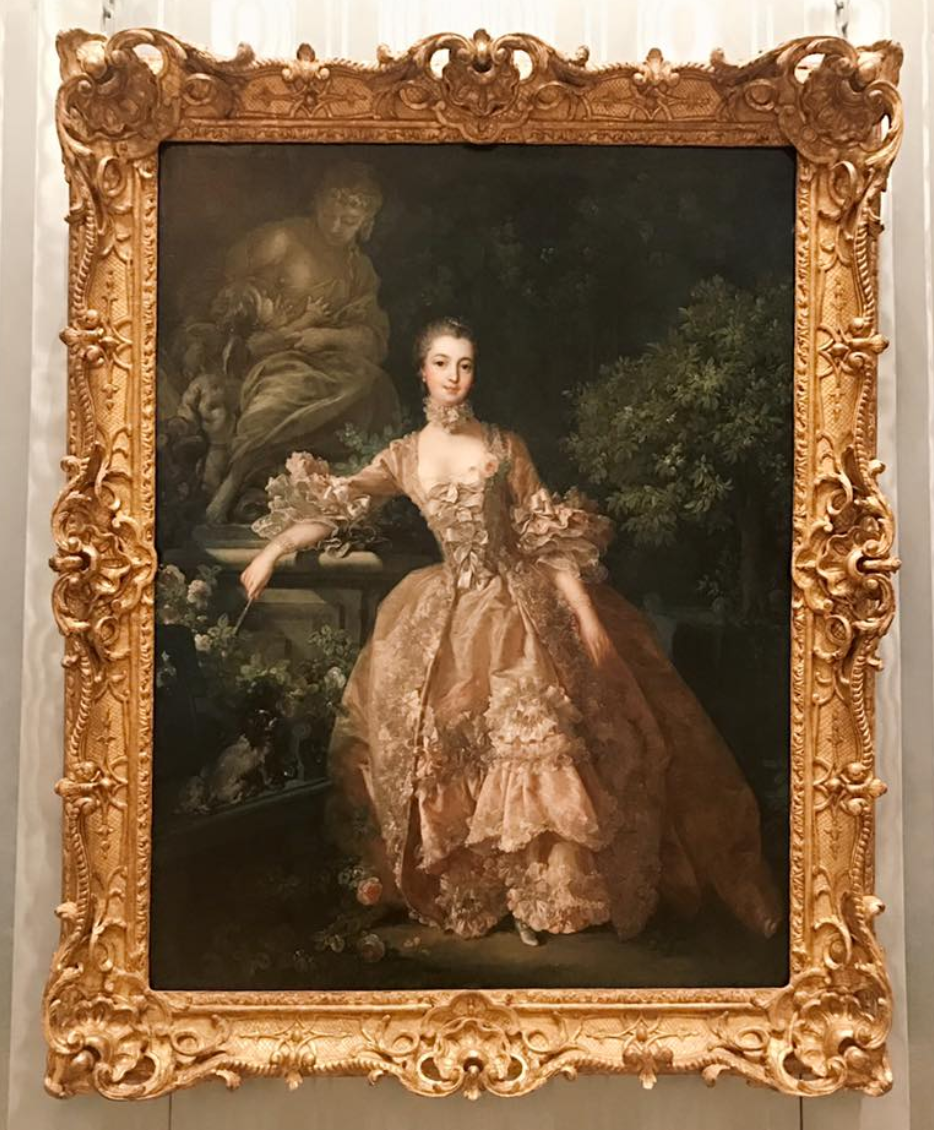
Another Boucher in this room is a painting entitled Madame de Pompadour. Madame de Pompadour was the most famous mistress of Louis XV. She was very influential as a patron of the arts and a political advisor to the King. This painting was commissioned by Boucher to help establish her power and prominent position at court. Even after her sexual relations ended with the King, she still remained at court in a political role, and this painting was made during that time period. Boucher included several symbols in a sort of propagandistic manner to underline her important role. For example, the dog in the bottom of the portrait represents fidelity and the excess of plants and trees behind her represents her “natural” character.
The final painting that we looked at in the Wallace Collection was Francesca da Rimini by Ary Scheffer. This painting is a direct contrast to Rococo because it was made for the Salon. There were strict rules regarding what type of art could be exhibited in the Salon, and this one adheres to the regulation that most paintings had to be history paintings of classical or biblical figures. This painting also lacks the visible brushstrokes that were present in the aforementioned Rococo paintings.
xx


Comments